Abstract: Peptides represent a rapidly expanding class of therapeutics capable of targeting protein surfaces and interfaces inaccessible to conventional small molecules. Yet our ability to study their behavior in living systems remains limited by the tools available. Traditional fluorescent labels are often too bulky to be incorporated without disrupting peptide function and target engagement. My research program develops minimally perturbative vibrational imaging tools to visualize peptide dynamics in complex biological environments. By integrating precision peptide design, bioorthogonal Raman tags and advanced spectroscopic imaging, we create platforms that enable noninvasive, chemically specific mapping of therapeutics in cells and tissues.
Abstract: Peptides represent a rapidly expanding class of therapeutics capable of targeting protein surfaces and interfaces inaccessible to conventional small molecules. Yet our ability to study their behavior in living systems remains limited by the tools available. Traditional fluorescent labels are often too bulky to be incorporated without disrupting peptide function and target engagement. My research program develops minimally perturbative vibrational imaging tools to visualize peptide dynamics in complex biological environments. By integrating precision peptide design, bioorthogonal Raman tags and advanced spectroscopic imaging, we create platforms that enable noninvasive, chemically specific mapping of therapeutics in cells and tissues.
Abstract: The presenter's Ph.D. in chemistry (chemical biology path) focused on harnessing peptide chemistry with structural and biophysical approaches to uncover how subtle changes in peptide architecture can be used to reshape GPCR signaling and immune signaling in useful ways.
For his postdoctoral work, he turned his focus to proteostasis by pursuing biological characterization of small-molecule activators of autophagy discovered via a high-throughput, imaging-based screen. This public seminar will highlight some of these research findings. In his future independent lab, Russ seeks to scrutinize and therapeutically harness GPCR and kinase networks to address novel questions at the interface of chemical biology, signal transduction and drug discovery.
Abstract: The presenter's Ph.D. in chemistry (chemical biology path) focused on harnessing peptide chemistry with structural and biophysical approaches to uncover how subtle changes in peptide architecture can be used to reshape GPCR signaling and immune signaling in useful ways.
For his postdoctoral work, he turned his focus to proteostasis by pursuing biological characterization of small-molecule activators of autophagy discovered via a high-throughput, imaging-based screen. This public seminar will highlight some of these research findings. In his future independent lab, Russ seeks to scrutinize and therapeutically harness GPCR and kinase networks to address novel questions at the interface of chemical biology, signal transduction and drug discovery.
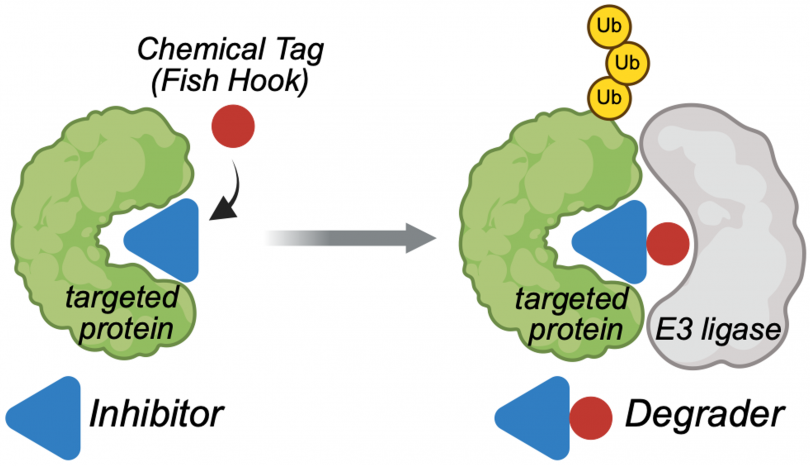
Small molecules that induce protein interactions hold tremendous potential as new medicines, as probes for molecular pathways and as tools for agriculture. Explosive growth of targeted protein degradation drug development has spurred renewed interest in proximity inducing molecules and especially molecular glue degraders. These compounds catalyze destruction of disease-causing proteins by reshaping protein surfaces and promoting cooperative binding between ubiquitylating enzymes and target proteins.
Molecular glue discovery for pre-defined targets is a major challenge in contemporary drug discovery. Here I will discuss how we address these chemical challenges through molecular glue discovery enabled by targeted degron display. By leveraging mechanisms such as electrophilic covalent bonding, electrostatic interactions, or cation-pi interactions, I have identified a range of potent molecular glue degraders that recruit previously unligandable ubiquitylating factors for multiple therapeutically relevant epigenetic regulators and kinases. This "chemocentric" approach provides a powerful strategy to discover molecular glues that induce proximity to ubiquitin ligases with similarly desirable properties.
Small molecules that induce protein interactions hold tremendous potential as new medicines, as probes for molecular pathways and as tools for agriculture. Explosive growth of targeted protein degradation drug development has spurred renewed interest in proximity inducing molecules and especially molecular glue degraders. These compounds catalyze destruction of disease-causing proteins by reshaping protein surfaces and promoting cooperative binding between ubiquitylating enzymes and target proteins.
Molecular glue discovery for pre-defined targets is a major challenge in contemporary drug discovery. Here I will discuss how we address these chemical challenges through molecular glue discovery enabled by targeted degron display. By leveraging mechanisms such as electrophilic covalent bonding, electrostatic interactions, or cation-pi interactions, I have identified a range of potent molecular glue degraders that recruit previously unligandable ubiquitylating factors for multiple therapeutically relevant epigenetic regulators and kinases. This "chemocentric" approach provides a powerful strategy to discover molecular glues that induce proximity to ubiquitin ligases with similarly desirable properties.
Compared to ubiquitous functional groups such as alcohols, carboxylic acids, amines and amides, which serve as central “actors” in most organic reactions, sulfamates, phosphoramidates and di-tert-butyl silanols have historically been viewed as “extras."
Largely considered functional group curiosities rather than launchpoints of vital reactivity, the chemistry of these moieties is underdeveloped. Our research program has uncovered facets of reactivity of each of these functional groups, and we are optimistic that the chemistry of these fascinating molecules can be developed into general transformations useful for chemists across multiple disciplines. In the ensuing sections, I will describe our efforts to develop new reactions with these “unusual” functional groups, namely sulfamates, phosphoramidates, and di-tert-butyl silanols.
Compared to ubiquitous functional groups such as alcohols, carboxylic acids, amines and amides, which serve as central “actors” in most organic reactions, sulfamates, phosphoramidates and di-tert-butyl silanols have historically been viewed as “extras."
Largely considered functional group curiosities rather than launchpoints of vital reactivity, the chemistry of these moieties is underdeveloped. Our research program has uncovered facets of reactivity of each of these functional groups, and we are optimistic that the chemistry of these fascinating molecules can be developed into general transformations useful for chemists across multiple disciplines. In the ensuing sections, I will describe our efforts to develop new reactions with these “unusual” functional groups, namely sulfamates, phosphoramidates, and di-tert-butyl silanols.