 Abstract: Cancer cells have developed uncanny strategies to evade the effectiveness of anticancer therapies and immune destruction by modulating their energy metabolism to a pro-survival state. This altered metabolism supports their proliferation and enables niches to thrive even in the presence of unfavorable conditions.
The glycolytic and the mitochondrial-mediated energy generation pathways represent some of the most dysregulated energy pathways in tumorigenesis. Metabolic profiling has shown the upregulation of glycolysis, oxidative phosphorylation, and the dual dependence of most cancers on both pathways for energy, in a need-dependent manner.
Here, I report on strategies that leverage the multiple energy pathway dependence of triple-negative breast cancer (TNBC) as a therapeutic approach; identify a novel energy metabolism-perturbing therapeutic target; and elucidate the role of endogenous and exogenous mitochondrial perturbation in breast cancer metastasis and progression.
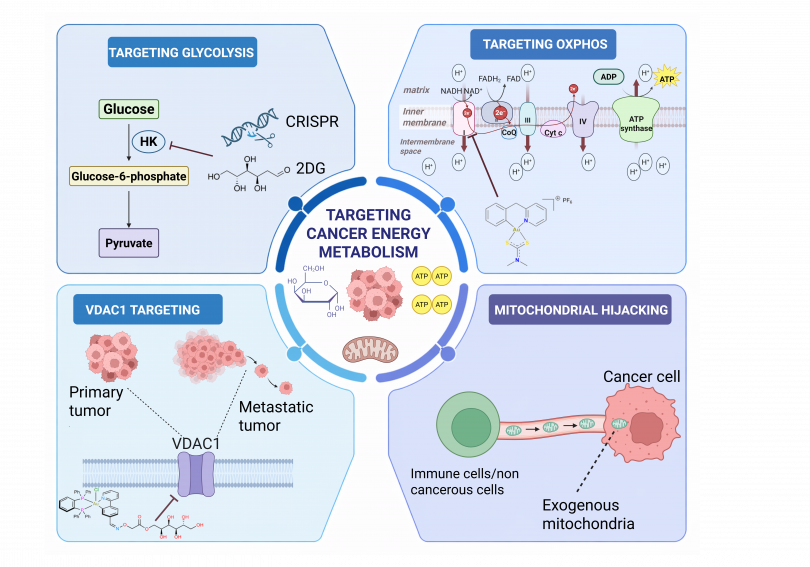
The excessive energy demand of the highly proliferative TNBC is a crucial driver of metabolic plasticity. I hypothesized that targeting multiple metabolic pathways in a dual-therapy approach in cancer will provide a profound exploitation of metabolic vulnerabilities for efficacious treatment regimens. Thus, I leveraged this energy gluttony to develop a strategy that targets both glycolysis and oxidative phosphorylation, using 2-deoxyglucose (2DG), a hexokinase (HK) inhibitor, and an OXPHOS-targeting gold(III) anticancer agent, respectively.
The in vivo anticancer response demonstrated improved synergy. However, the non-specificity of 2DG in targeting hexokinase led to a specific CRISPR-Cas9-mediated manipulation of HK1, HK2, and HK3 respectively in TNBC cells. Further rigorous target validation studies culminated in the identification of HK3 as a promising therapeutic target in TNBC, revealing it to be a previously uncharacterized and markedly understudied isoform.
In efforts to glean more insights into cancer energy metabolism and the mitochondrial-modulatory potency of gold(III) complexes, I validated the antitumorigenic, antimetastatic and energy stress-inducing effects of targeting voltage-dependent anion channels 1 (VDAC1), the main regulator of metabolite flux between mitochondria and cytosol, in TNBC using various in vitro and in vivo models.
Exogenous mitochondria transfer, a term that describes the trafficking of mitochondria from external donors to cancer cells, has gained traction as an emerging concept in cancer energy metabolism. To further our understanding of this concept, I have shown that cancer cells hijack the mitochondria of immune cells, resulting in depletion of metabolic energy available to the immune cells. This study identifies a new therapeutic target and unveils new insight into our understanding of targeting energy metabolism in cancer.