
Abstract: The growing need to substitute fossil energy sources with cleaner liquid transportation fuels has led to a proliferation of catalytic technologies that convert a huge variety of feedstocks into useful commodities. Many of these processes have been deployed on an industrial scale, but barriers to full adoption and widespread commercialization remain.
These barriers include the expensive and unstable nature of catalyst materials, limited quality and or quantities of feedstock and the capital expenditures required to achieve economies of scale. One of the key ways in which these challenges may be overcome is through the development of improved catalysts- and the most effective means of enhancing catalyst performance is by better understanding the underlying chemistry. To that end, the sustainable and alternative fuels group at the UK Center for Applied Energy Research conducts research along three distinct but interrelated tracks that combine spectroscopic measurements, assessment of reaction performance and computational modelling to derive structure-activity relationships:
- The first track involves the development of catalytic materials to produce renewable diesel from fats oils and greases through the decarboxylation and decarbonylation reactions, a pathway that allows the use of inexpensive base metal catalysts whose lifetime has been enhanced by alloying of the active metals.
- Second, through the development of catalysts to produce fully formulated sustainable aviation fuel from fats oils and greases by tuning the type and strength of catalyst acid sites while maintaining the active metal sites needed for deoxygenation.
- Finally, the Center for Applied Energy Research has investigated the Fischer-Tropsch Synthesis for more than three decades. The synthesis is a process through which syngas (carbon monoxide and hydrogen) is converted to hydrocarbons over either iron or cobalt based catalysts, with products ranging from methane to long chain waxes. When gasified biomass or CO2 is used as the carbon source, renewable hydrocarbon fuels can be produced.
Equipped with an experimental database going back decades, the adoption of machine learning to guide catalyst development will greatly enhance the understanding of how these catalysts function while also dramatically accelerating the speed of catalyst development.
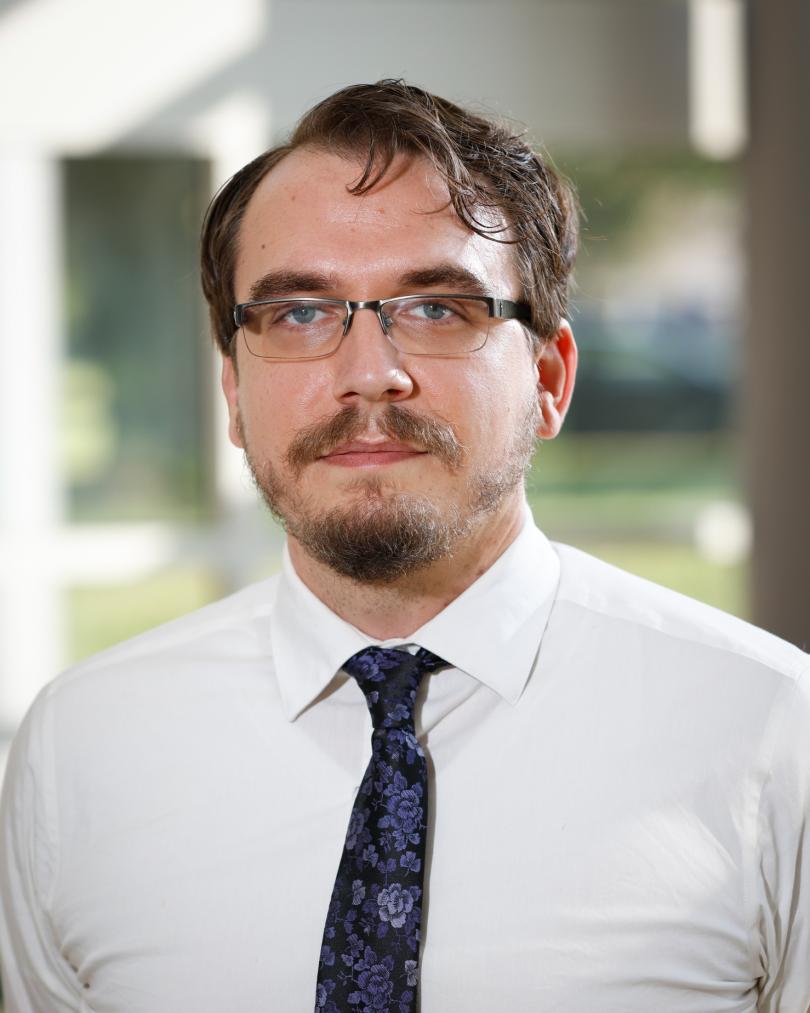 Biography: Dr. Robert Pace first joined UK as a temporary technician in the Biofuels and Environmental Catalysis group at the Center for Applied Energy Research in 2011. He was then hired into a permanent position as assistant research scientist and continued to work at CAER on various projects, including the decarboxylation/decarbonylation of waste lipids to fuel-like hydrocarbons, the fractionation of lignocellulosic and algal biomass to produce value-added products and the use of microalgae to capture power-plant CO2 emissions.
He subsequently joined UK’s chemistry graduate program in 2016, performing his doctoral research on the passive adsorption of NOx emitted during cold starts of automotive engines at the UK CAER under the guidance of Dr. Mark Crocker and Dr. Jack Selegue. After obtaining his Ph.D. in 2020, he returned to CAER as an Associate Research scientist, and within two years was promoted to Senior Research Scientist. Since completing his graduate degree, he has worked with the Biofuels Group; Clean Fuels and Chemicals Group; and Carbon Materials group. He also has helped to oversee the unification of the two CAER catalysis groups into the newly established Sustainable and Alternative Fuels group.
His current research focuses on the application of heterogeneous catalysis to the production of renewable fuels and chemicals with emphasis on the upgrading of waste oils to drop-in hydrocarbon fuels and the use of CO2 to produce synthetic fuels using the Fischer-Tropsch process.