Development of an effective Au:Pd bimetallic heterogeneous catalyst for oxidative lignin depolymerization to low molecular weight aromatics
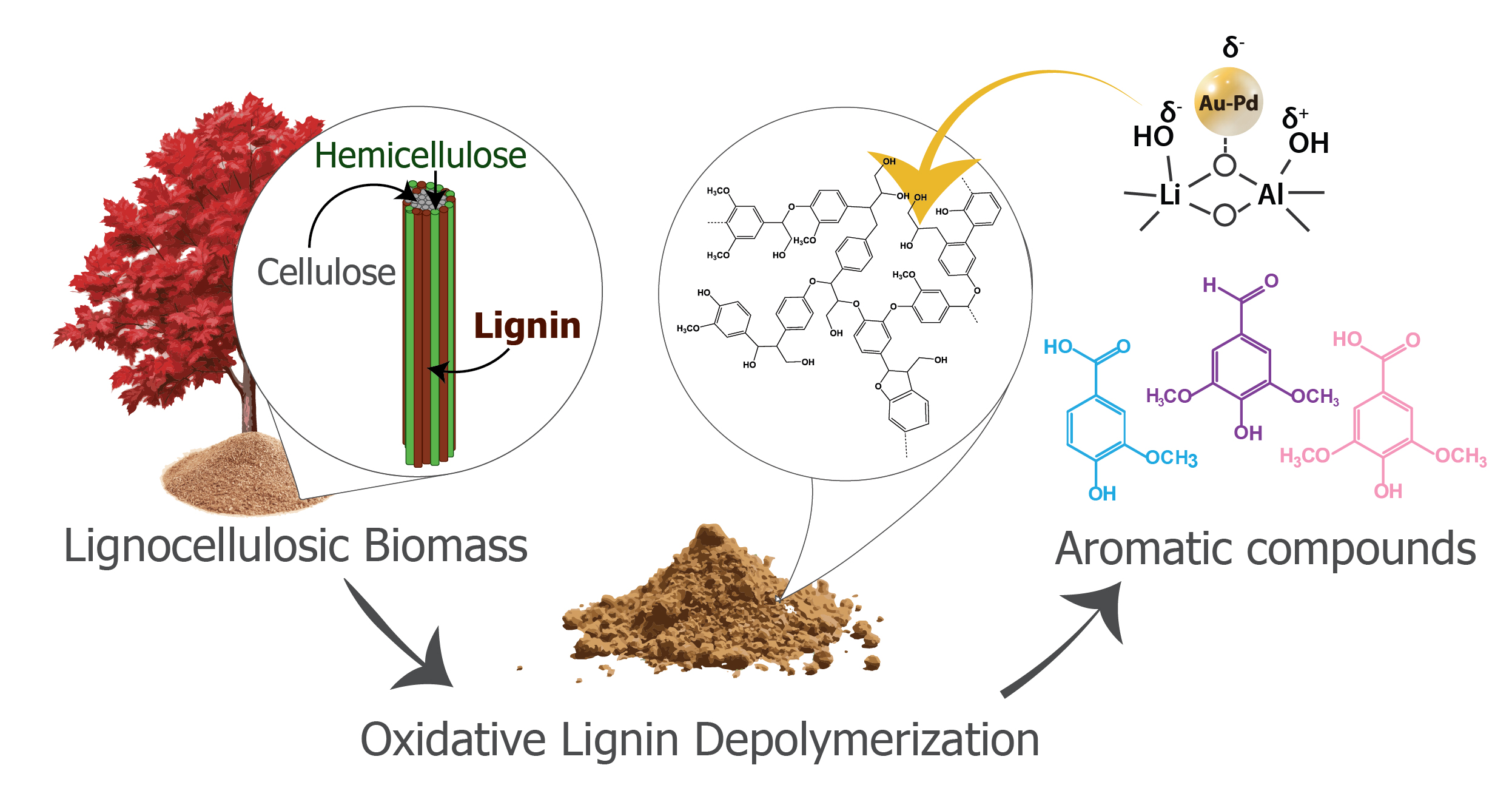
Abstract: The principal concept behind biorefining involves the transformation of lignocellulosic biomass into valuable products and energy resources. Historically, biorefinery strategies for lignocellulosic biomass have primarily focused on improving the conversion of cellulose into ethanol, often neglecting the underutilized lignin component. Lignin consists of phenolic subunits, from which it follows that value-added products can be obtained from lignin depolymerization. Unfortunately, lignin utilization is particularly challenging due to its high structural irregularity and recalcitrance. The goal of this study was to develop an AuPd/Li-Al layered double hydroxide (LDH) bimetallic catalyst for efficient lignin depolymerization, resulting in the production of high-value aromatic compounds. The structural complexity of lignin renders the study of individual reactions in lignin difficult. Therefore, model compounds were used to evaluate catalyst performance. Initially, we prepared AuPd bimetallic nanoparticles with varying molar ratios supported on a basic Li-Al LDH using a sol-immobilization method. Subsequently, we characterized the synthesized catalysts and evaluated them in aerobic oxidation reactions of 1-phenylethanol and simple benzylic alcohols at atmospheric pressure to identify the most effective catalyst configurations. Those catalysts demonstrating promising performance were further examined in the aerobic oxidation of lignin model dimers containing ß-O-4 linkages. Remarkably, these model compounds underwent sequential oxidation, ultimately leading to the cleavage of the ß-O-4 bonds. Subsequently, we evaluated the catalysts in the oxidative deconstruction of ?-valerolactone (GVL) extracted from maple lignin at 120 °C, again using O2 as the oxidant. These results highlight the potential of the AuPd/Li–Al LDH catalyst system as an eco-friendly approach for lignin depolymerization under mild conditions, offering a promising avenue for valorizing lignin in biorefining processes.