Abstract: Inkjet printing has emerged as a scalable, digitally programmable, and material-conservative deposition technique for functional inks, offering a maskless and contactless alternative to traditional fabrication methods. When combined with three-dimensional printing and light-based post-printing processing such as photonic or infrared curing, it enables the fabrication of functional materials on substrates with low thermal budget that are incompatible with traditional high-temperature processing.
The implementation of these synergistic additive manufacturing strategies in electrochemical applications, however, remains limited by challenges due to the challenge related to compatible ink formation and the stability of the inks. The substrate compatibility with sintering methods, and the difficulty of forming catalytically active nanostructures, such as single-atom catalysts, on supports is another interesting unexplored avenue.
This dissertation addresses these challenges through a series of interconnected studies spanning hybrid electrode fabrication, nanoparticle ink development, and the photonic conversion of metal precursors into functional catalytic species on both 2D support and flexible substrates.
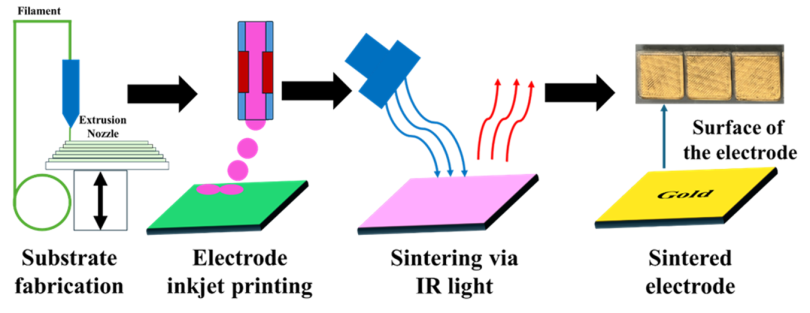
In this work, inkjet printing was first integrated with fused deposition modeling 3D printing and infrared-curing sintering to develop gold-based electrodes on polymer substrates. To address the limitations associated with commercial inks, a lab-synthesized gold nanoparticle ink was subsequently developed.
The control on nanoparticle size, colloidal stability and printability through systematic variation of synthesis and formulation parameters were studied. The role of solvent composition in regulating droplet behavior, drying dynamics, and film formation was also examined to investigate printing reliability and film uniformity.
The study was then extended to catalytic material systems, where photonic curing was explored as a novel approach for converting platinum precursors into active species on 2D material supports. The influence of precursor–support interactions, governed by their mixing prior to curing, was investigated to understand how these factors influence the formation of single atoms, clusters and nanoparticles.
Building on these insights, photonic curing was applied to delicate PEDOT:PSS nonwoven substrates, both as a surface modification technique and as a post-deposition conversion step following inkjet printing of platinum precursor. This approach enabled the generation of functional platinum species on a conductive, high-surface-area textile-like platform without compromising structural integrity.
Overall, this work demonstrates that the integration of inkjet printing with photonic and IR-based processing provides a versatile and substrate-compatible framework for fabricating metal-based functional materials. By systematically examining the relationships between ink formulation, deposition behavior, and post-processing conditions, this dissertation establishes design principles for the development of electrochemical electrodes and catalytic systems across a range of substrates and applications.