
By Motunrayo Oladele

LEXINGTON, Ky. (June 18, 2026) — Diffraction glasses, dry ice and red cabbage brought chemistry to life for eighth-grade students at Lexington Christian Academy during a University of Kentucky outreach visit.
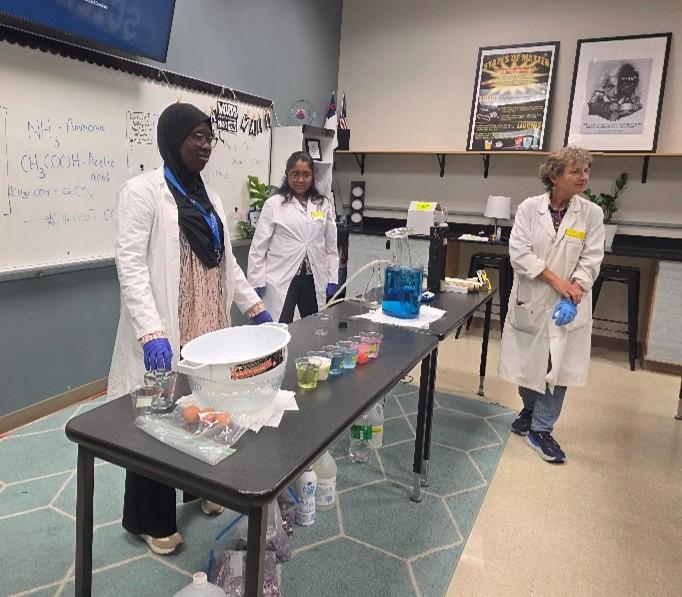
On May 4, Anne-Frances Miller, Ph.D., Gill Eminent Professor of Chemistry, and doctoral candidates Motunrayo Oladele, Lateefat Jimoh and Hashini Navarathne from the UK Department of Chemistry visited the school to lead demonstrations on atomic emission spectra, states of matter and acid-base chemistry. The activities connected classroom science to environmephoto of three students and a professorntal issues and everyday experiences.
Miller opened the session with an introduction to atomic structure and light and distributing diffraction glasses so students could observe how elements emit distinct light signatures.
“Many fascinating processes go unnoticed in the world around us because people do not think to question them,” Miller said. “But when we explore these phenomena through hypotheses and experiments, students not only learn science; they gain confidence and become empowered to explore their world with greater curiosity. Those moments can change attitudes in ways that enrich all aspects of their lives.”
Jimoh, a third-year doctoral candidate, led students through an acid-base chemistry activity, asking them to classify common household substances along the pH scale. The discussion prompted students to ask about chemical indicators, including why red cabbage changes color when heated.
Navarathne, also a third-year doctoral candidate, demonstrated states of matter using dry ice in a container connected to an inverted graduated cylinder submerged in water. As the dry ice sublimated, gas displaced the water in the cylinder, giving students a visual example of gas volume.
“Science becomes real when you can see it,” Navarathne said. “Learning becomes something you experience rather than simply memorize when ideas take shape in the world around you.”
Oladele, a fourth-year doctoral candidate, led the atomic emission spectra demonstration, where students used diffraction glasses to observe how different elements produce unique light signatures.
“I enjoy participating in outreach because it allows me to connect with students and show them that science can be both exciting and meaningful,” Oladele said. “I hope to continue pursuing opportunities in education alongside my research.”
The graduate students also connected chemistry concepts to environmental issues by explaining how carbon dioxide contributes to ocean acidification and affects aquatic organisms with calcium-based shells. Demonstrations comparing eggshells soaked in vinegar with tooth enamel exposed to acidic beverages helped students connect chemistry concepts to everyday life.
Throughout the session, the team emphasized laboratory safety by modeling proper personal protective equipment and chemical-handling practices. The outreach visit also gave doctoral candidates an opportunity to engage with the community while demonstrating how chemistry relates to global challenges. The team hopes experiences like these will inspire students to continue exploring science.